
Symbiosis Project (SP) is a design lab exploring how a Type 1 civilization would harmonize the biosphere with the technosphere. We aim to create regenerative and sustainable design solutions by working with nature’s best practices to imagine bio-hybrid systems, biomaterials and design futures.
SP is where designers, engineers, life science experts, and technologists collaborate to create novel concepts that act as blueprints for Type 1 designs. Each project, whether it’s developing near future conceptual designs or far future design fictions/ concept art, serves as a rehearsal for futures where biology and technology evolve in symbiosis.
“I think the biggest innovations of the 21st century will be at the intersection of technology and biology.”
-Steve Jobs
According to scientist Nikolai Kardashev’s scale of civilizations, a Type 1 civilization represents a planetary society, able to meet its energetic needs by engaging the forces of its environment and shaping the built environment as an extension of the natural environment. Here design becomes a tool to create futures where biology and technology co-exist as one continuous ecology.
TYPE 1 Design Philosophy
Working Across Disciplines
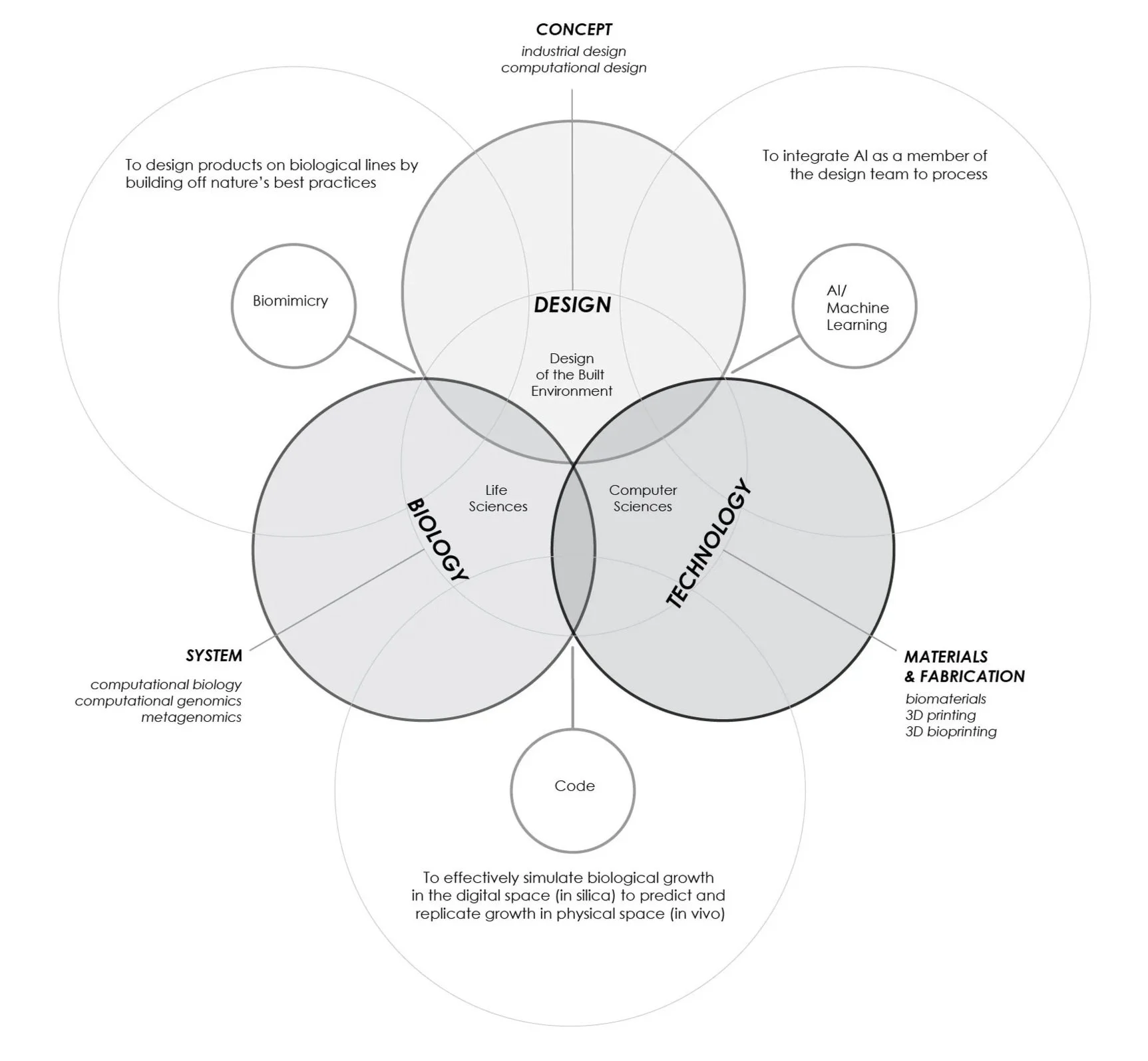
Symbiosis Project. Lab structure. Source: Yves A. Michel.
Transdisciplinary collaboration opens up new ways of conceptualizing as it enables all participants to observe a problem through their disciplinary lenses as well as being to open explore new perspectives and possibilities by sharing and learning across disciplinary silos.
Symbiosis Project aims to build a team to create novel biodesign solutions and create a design process to “grow” products in close collaboration between design, biology, chemistry, computer science, 3D bioprinting, and machine learning.
From biology to bioGana: An analogy
The goal of this research practice is not to design products by replicating nature as it is but to design by referencing nature’s best practices and build on that foundation to design products on biological lines structured and biofabricated in a manner that is much less complex structurally than the biological reference.
Hence the analogy of being inspired by nature (biological kanji) to create BioGana (biological hiragana), or better yet, a BioKana (biological katakana) design solutions.
To design with nature’s sophistication without the complexity.
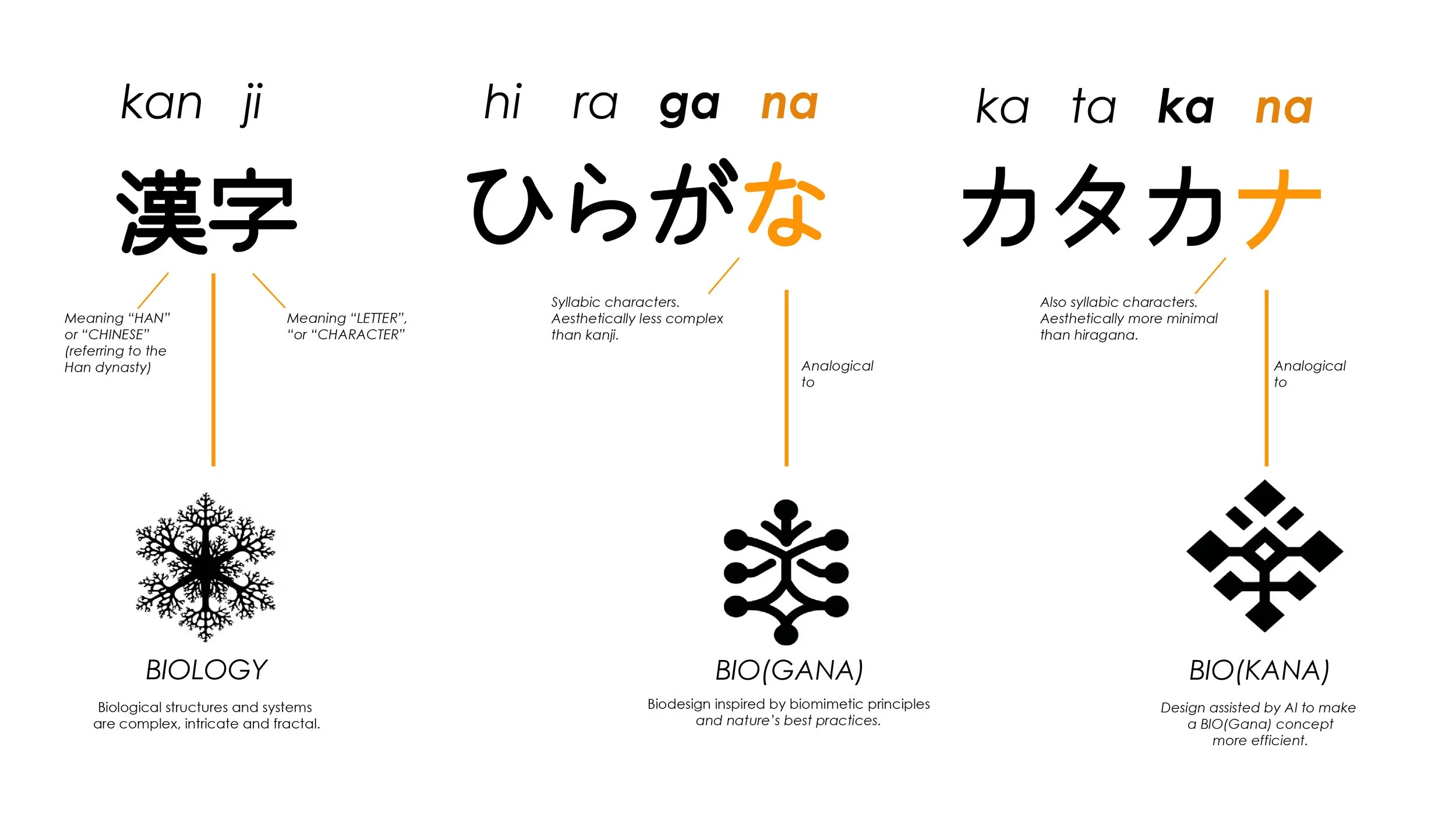
Kanji to Hiragana and biology to biodesign analogy illustrated. Source: Yves A Michel.
“You cannot solve a problem with the same mind that created it.”
- Albert Einstein
Speculative Design as Research Method
conceptual design to push the boundaries of convention by exploring blue sky future concepts, and innovative ideas. It is the exploration and experimentation of form, function, materiality, and biomanufacturing to communicate abstract ideas through design.
design fiction to explore the use of artifacts designed for a near or far future fictional scenarios and story-telling to provoke discussions about potential of emerging technologies and the future of mankind.
Conceptual Design/ Project Phases
-
Concept_ In this phase the team creates a near future design solution to a design problem. We ideate a concept by researching the most relevant biological references, understanding the latest in biotechnology, and by finding alternative applications of emergent technologies to our concept. AI can be employed to help cataloging and synthesizing research papers and scientific references.
The deliverable at the end of this phase is a diegetic prototype by means of 3D printing to serve the function of communicating the concept to the larger public.
-
Digital Proof-of-Principle_ In this phase the team collaborates with experts from the life sciences and computer sciences to investigate how to build and test the concept in simulation. By using computation and biological algorithms to test feasibility and growth, the team can theoretically demonstrate how the concept functions in silico which allows to run multiple scenarios and reduce the elements of time, risk, and cost associated with wet labs. AI will be integrated in the process to support the team to take the first iterations of the design (BioGana concept) to a more minimal and efficient system (BioKana concept).
This phase will see the creation of a digital wet lab to guide the transition fromexperimentation insilicotophysical experimentation. The deliverable at the end of this phase is a digital proof-of-principle (PoP).
-
Proof-of-Concept_ In this phase the team and collaborators will use the BioKanaconcept produced in phase 2 and the information gathered to “grow” the samples, components and eventually a full concept by means of 3D bioprinting and self-assembly.